

CALM the Conversation
Responding to Defensiveness at Work
INTERACTIVE E-LEARNING · ARTICULATE STORYLINE
A scenario-based learning experience that helps managers practice more productive responses during difficult workplace conversations.
Audience: New managers, supervisors, and emerging leaders
Length: Approximately 8–10 minutes
Inside the Learning Experience
Opening decision
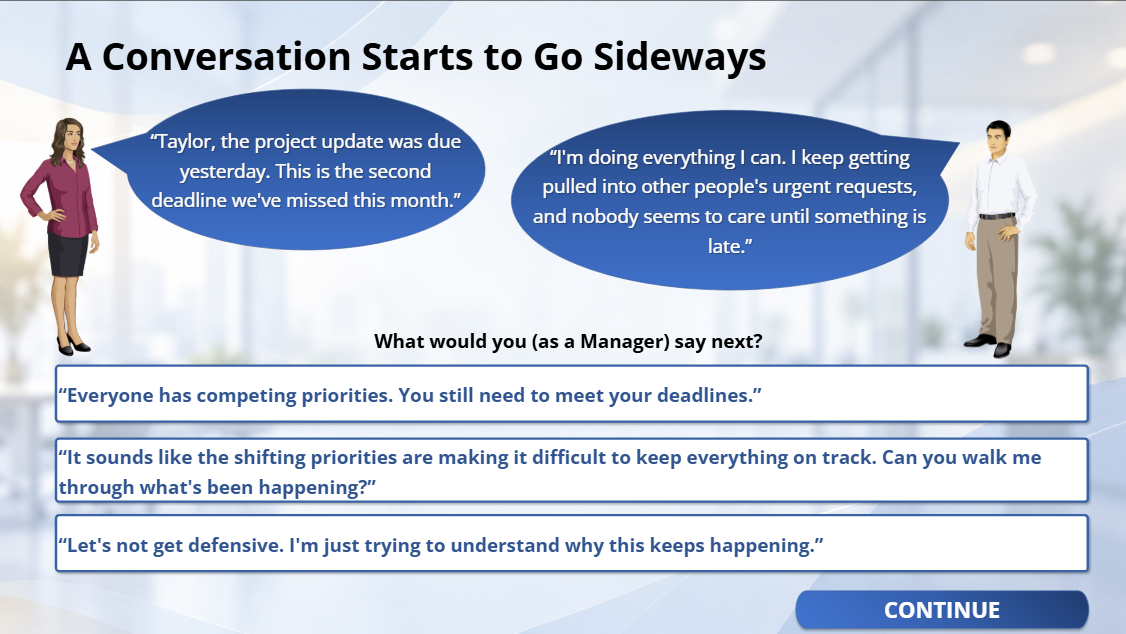
Learners respond to an employee's frustration before receiving formal instruction, making the communication challenge immediately relevant.
An interactive four-step strategy helps learners organize their thinking and prepares them for later practice.
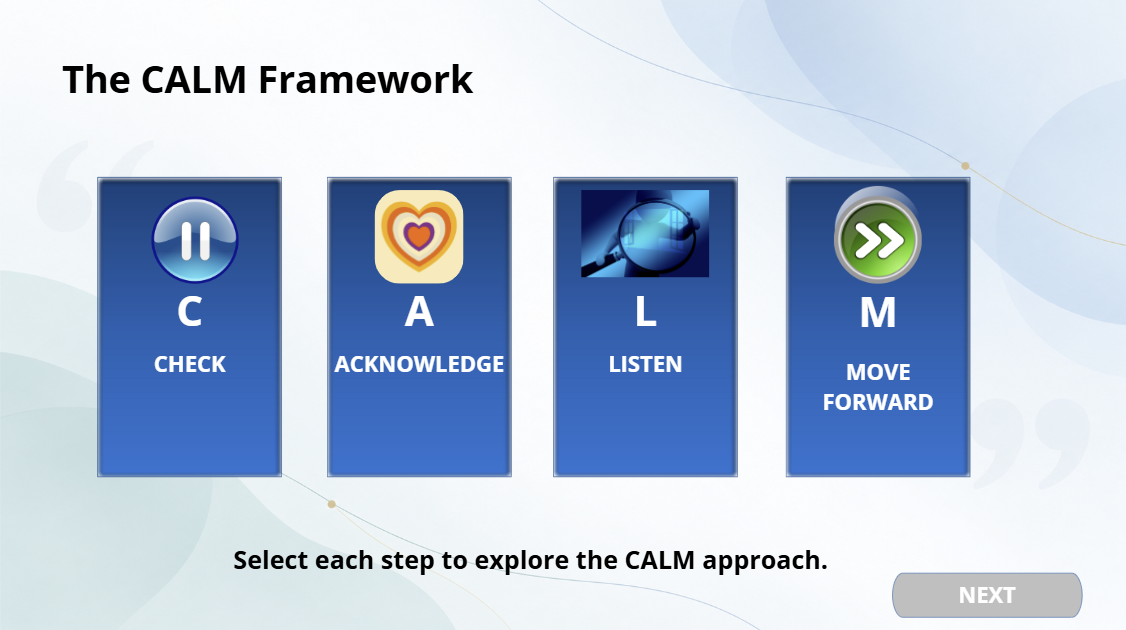
CALM framework
Different dialogue choices produce different reactions, allowing learners to examine the consequences of their decisions.
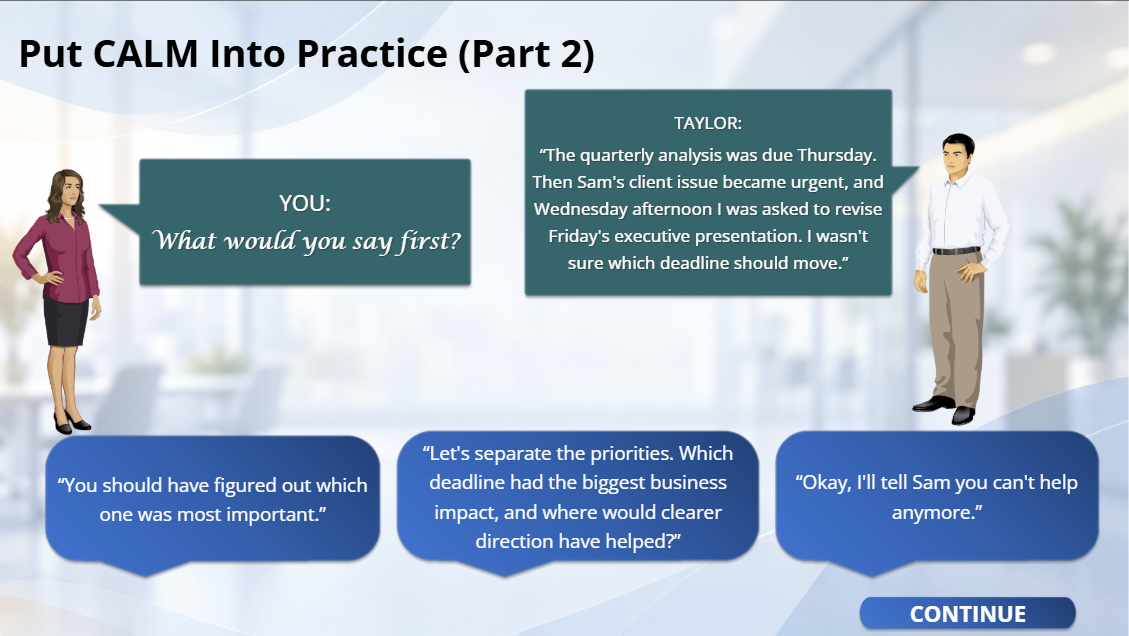
Branching workplace conversation
CALM the Conversation: Instructional Design Approach
Julie Dirksen's Design for How People Learn influenced how I approached this project, particularly her emphasis on designing for what learners need to do rather than simply what they need to know.
I wanted learners to encounter a realistic communication challenge from the very beginning. Instead of explaining why defensiveness occurs and then testing their recall, the opening scenario asks them to make a decision. The employee's reaction makes the consequences of that choice visible and creates a reason to learn a better approach.
The CALM framework then gives learners a simple structure they can return to as the conversations become more challenging. Branching scenarios provide opportunities to practice, while feedback helps learners understand why one response may be more productive than another.
I also wanted the module to show that supportive communication does not mean avoiding accountability. Managers still need to address performance concerns, but they can do so without making employees feel immediately judged or dismissed.
This project reinforced an important lesson for me: effective instructional design is not about presenting information as clearly as possible and hoping learners remember it. It is about creating opportunities for people to develop the judgment they will need when they return to their everyday work.
Reference:
Dirksen, J. (2016). Design for how people learn (2nd ed.). New Riders.

Personal Reflection
Developing this module helped me think more carefully about how to teach skills that are difficult to learn through explanation alone. Workplace communication is a good example. Most managers already know that listening is important, but recognizing the right moment to listen—especially when a conversation becomes tense—is much harder.
Articulate Storyline gave me a way to explore that challenge through interactive decisions. I particularly enjoyed designing the branching conversations because they allowed me to connect the learning content to the emotional consequences of a manager's response.
This project also reminded me that technology is most valuable when it serves a clear learning purpose. My goal was not to include interactivity for its own sake, but to use it to make the practice more meaningful.
I hope to continue exploring how scenario-based learning can help professionals build confidence before applying new skills in the workplace.